Fri Feb 20 2026
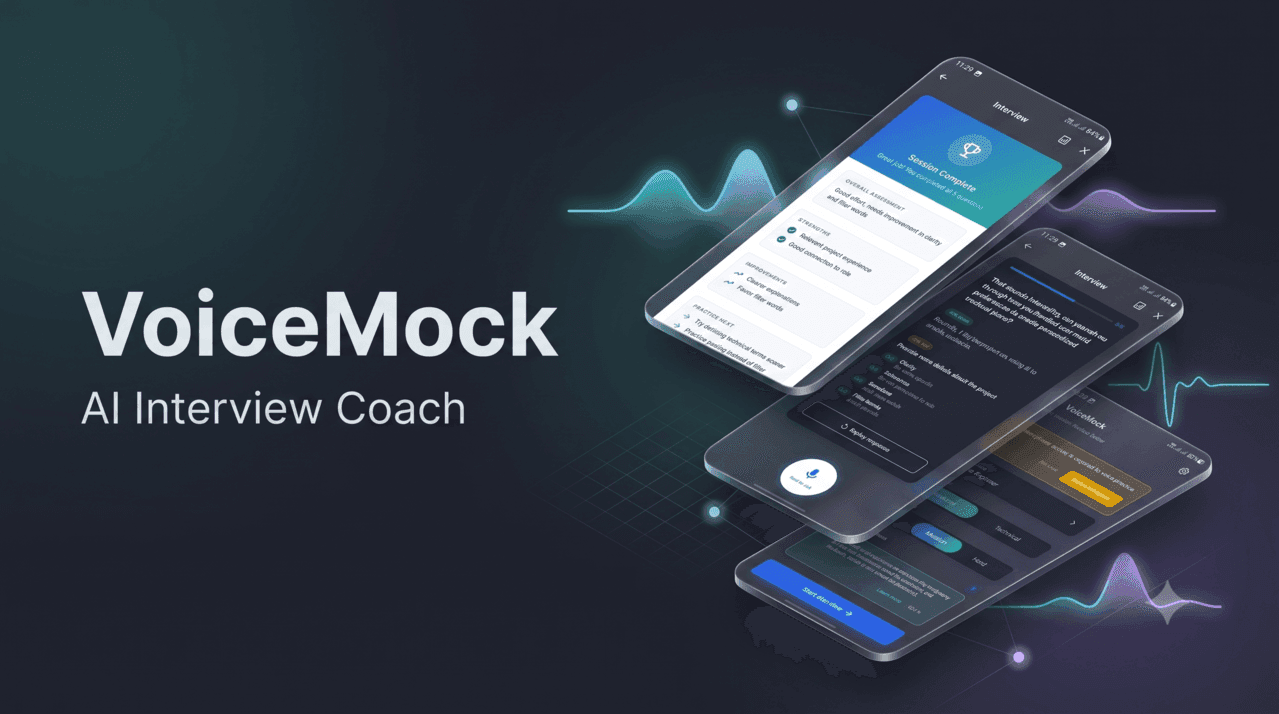
VoiceMock is a voice-first AI interview coach that puts you inside a realistic job interview simulation. You hold a button to speak your answer, the app transcribes it, generates a contextual follow-up question using an LLM, and plays back the AI interviewer's response — all in under 3 seconds. At the end of each session, you get a detailed coaching summary covering clarity, structure, confidence, and filler-word usage.
Most existing interview prep tools are either static question lists or text-only chatbots. VoiceMock is voice-native by design, giving job seekers a low-stakes environment to practice the actual experience of speaking in an interview.
Screenshots
| Home / Setup | Interview Screen | Session Summary |
|---|---|---|
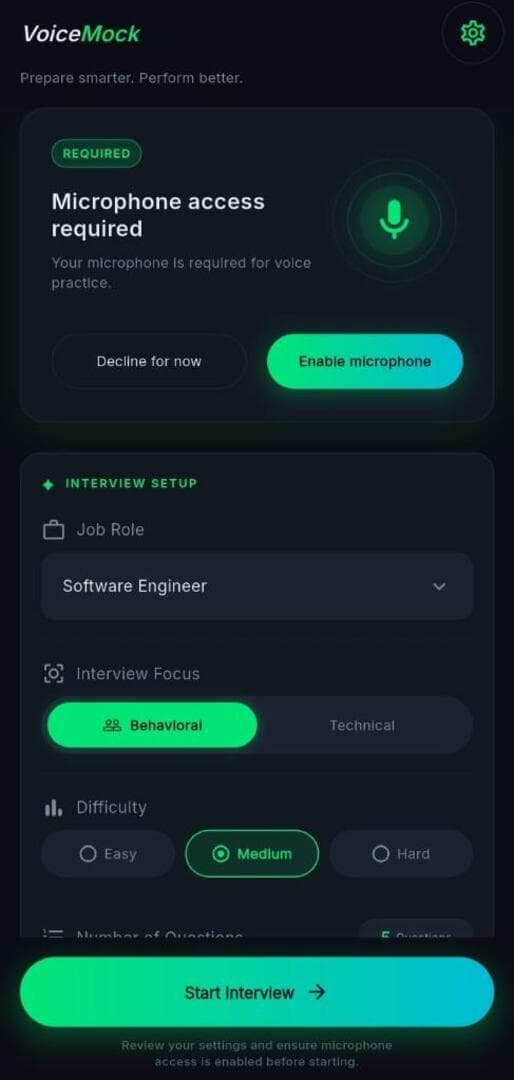 | 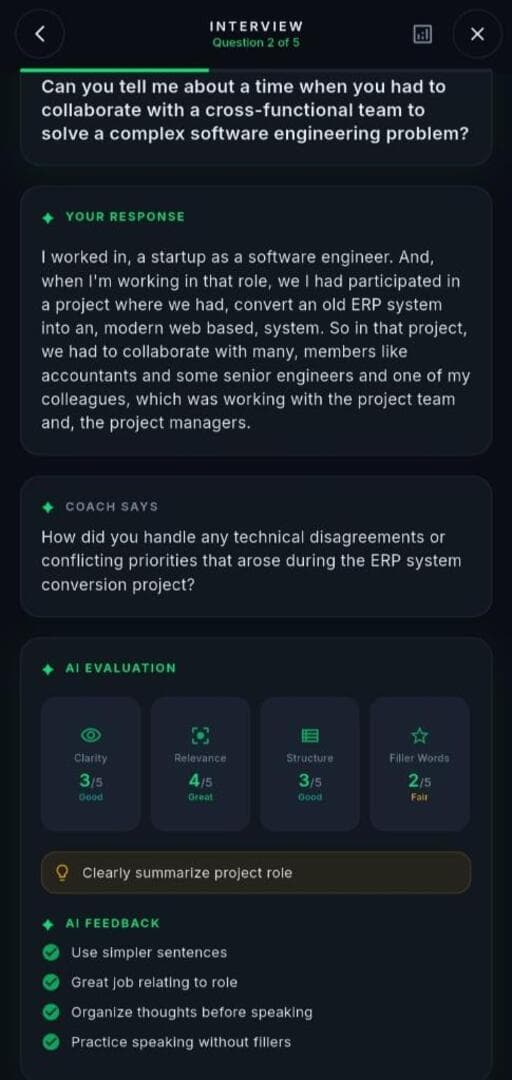 | 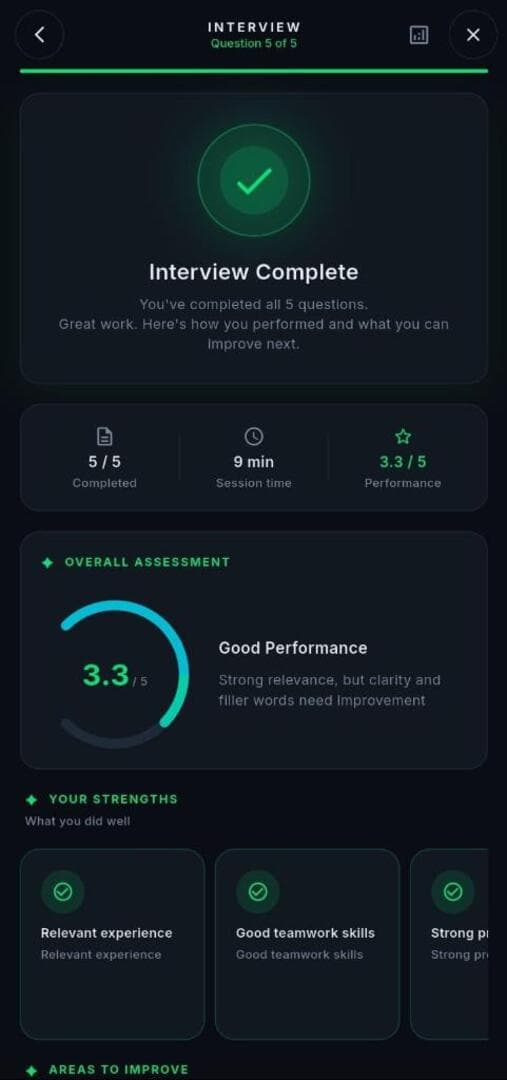 |
| Recording State | Error Recovery | Diagnostics | Settings Screen |
|---|---|---|---|
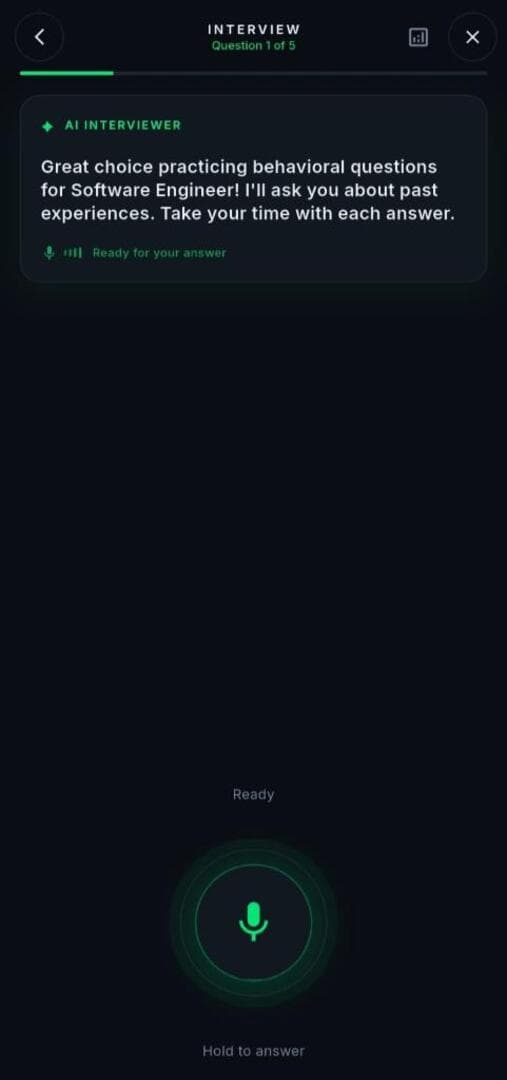 | 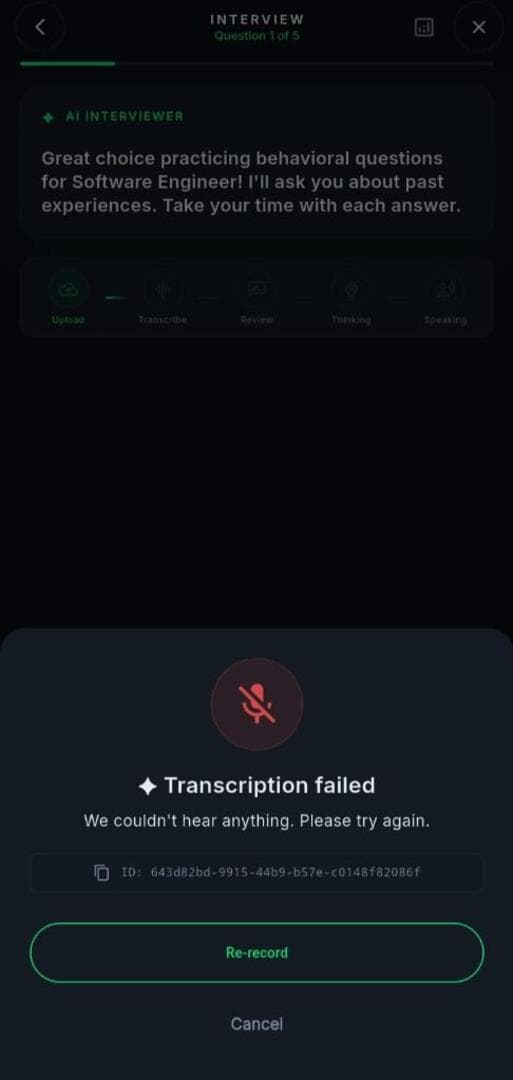 | 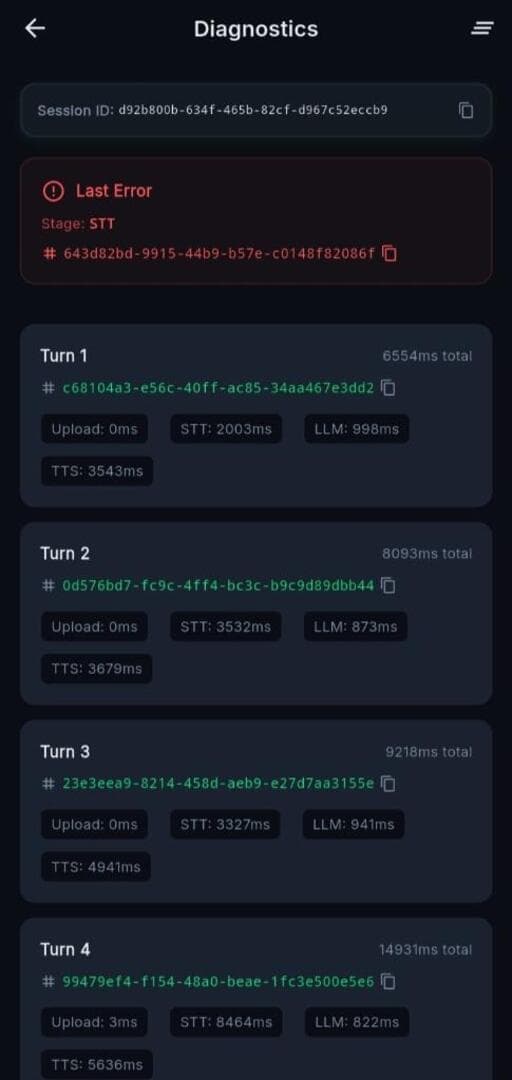 | 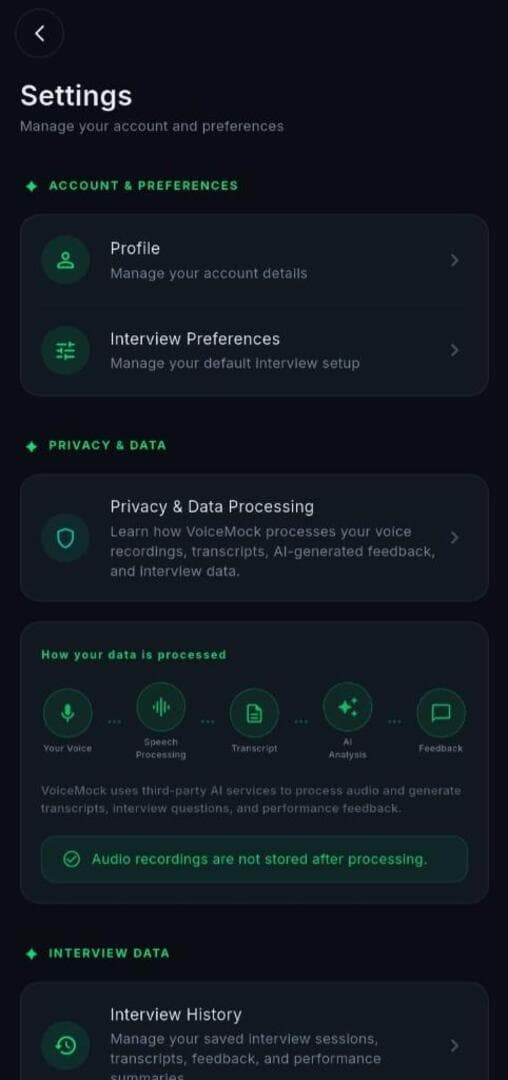 |
Features
- Push-to-talk recording — hold to answer, release to send; no barge-in confusion
- Adaptive follow-up questions — the AI reacts to your answer, not a fixed script
- Voice playback — the AI interviewer speaks back in a natural TTS voice
- Transcript trust layer — review your transcribed answer and re-record if needed
- End-of-session coaching summary — grammar, clarity, confidence, structure, and filler-word analysis
- Latency-first design — P50/P95 voice loop kept under 3 seconds (STT → LLM → TTS)
- Stage-aware error recovery — every failure carries a stage, retryable flag, and request ID so users always know what to do next
- Privacy by default — raw audio is never stored; transcripts are session-scoped and deletable
Tech Stack
- Mobile: Flutter with
flutter_blocCubit state machine andgo_routerfor navigation - Audio:
recordfor capture,just_audiofor playback,audio_sessionfor session management - Backend: FastAPI (Python 3.11+) with Uvicorn, deployed on Render via Docker
- Speech-to-Text: Deepgram Nova-2 for fast, accurate transcription
- LLM: Groq Llama 3 for sub-second contextual question generation
- Text-to-Speech: Deepgram Aura for natural-sounding AI voice responses
- Validation: Pydantic v2 for strict request/response contracts
- Security:
itsdangeroussigned session tokens,slowapirate limiting - CI/CD: GitHub Actions with separate pipelines for mobile and API
How It Works
The core of VoiceMock is a voice agent loop running on a strict state machine:
- Record — User holds the talk button; audio is captured locally
- Upload — Audio is sent to the FastAPI backend via multipart POST
- Transcribe — Deepgram Nova-2 converts speech to text
- Generate — Groq Llama 3 produces a contextual follow-up question based on the answer
- Synthesize — Deepgram Aura converts the question text to audio
- Playback — The mobile app fetches and plays the audio response
- Repeat — After 5 turns, the session ends with a full coaching summary
The two-step TTS fetch (POST returns JSON, then GET fetches audio) lets the client display the transcript and question text immediately — improving perceived responsiveness without waiting for the audio to be ready.
Architecture Highlights
The mobile app uses a feature-first Flutter structure with flutter_bloc as the single source of truth for interview flow. The state machine enforces strict transitions — Ready → Recording → Uploading → Transcribing → Thinking → Speaking — with hard guards preventing concurrent recording and playback.
The backend follows a Provider Adapter pattern: a central orchestrator pipeline wires together the STT, LLM, and TTS providers, each swappable independently. All API responses use a consistent JSON envelope { data, error, request_id } for predictable client handling.
Sessions are held in-memory with TTL expiry — no database needed for the MVP. A Redis swap is a single-layer change when scaling is required.
Challenges & Solutions
Sub-3-second latency was non-negotiable for a voice app to feel natural. Achieving this required choosing providers specifically for raw speed (Groq's inference hardware, Deepgram's streaming transcription), fine-tuning timeout budgets per pipeline stage, and the two-step TTS design so the client isn't blocked waiting for audio before showing text.
Audio state machine correctness was harder than expected. Double-speak (overlapping TTS playback) and UI freezes during state transitions were fixed by making the Cubit the single source of truth — no concurrent audio states possible, and no boolean flags living outside the machine.
Stage-aware error recovery made a huge UX difference. Instead of a generic "something went wrong", each pipeline stage produces a typed error with a retryable flag and request_id, so the UI can offer the right action: retry, re-record, or cancel — never a dead end.
Future Plans
- Voice Activity Detection (VAD) to remove push-to-talk friction
- Streaming responses for lower perceived latency
- Role-specific question packs (React, Flutter, Product, etc.)
- Resume upload to tailor questions to real experience
- Session history and improvement tracking with charts
- Multi-language support and pronunciation feedback